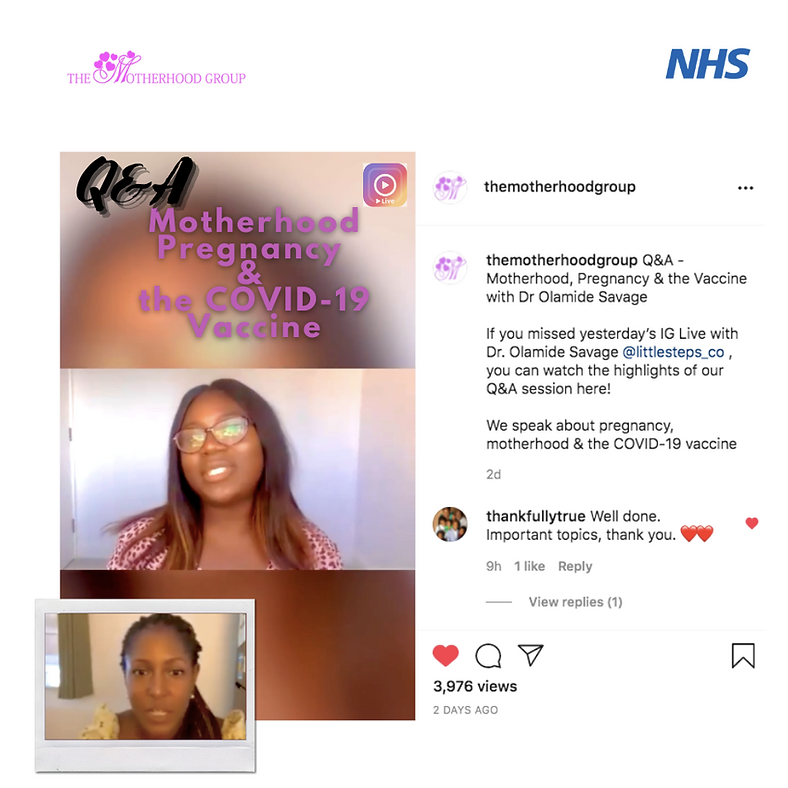
Motherhood, Pregnancy & the Vaccine ft. Dr Olamide Savage
15 June 2021
Q&A - Motherhood, Pregnancy & the Vaccine ft. Dr Olamide Savage
If you missed Friday's IG Live with Dr. Olamide Savage and Sandra Igwe, you can watch the highlights of our Q&A session here! We speak about pregnancy, motherhood & the COVID-19 vaccine, she answered questions that we've always wanted to know.
Below, we've also captured the main questions asked and Dr. Savage's response in this blog post.
Pregnancy
Many women in our network are currently pregnant, are they able to have the vaccine?
The JCVI advises that all pregnant women should be offered the COVID-19 vaccine at the same time as the rest of the population, based on their age and clinical risk group.
Are there any studies into the COVID-19 vaccine and pregnant women to show the benefits?
The study aims to further understand the safety, tolerability and immunogenicity of the Pfizer-BioNTech COVID-19 vaccine in healthy pregnant women, with approximately 235 volunteers involved throughout the UK.
Real-world data from the United States – where around 100,000 pregnant women have been vaccinated mainly with mRNA vaccines, such as Pfizer-BioNTech and Moderna – have not raised any safety concerns.
Breastfeeding
Let’s talk about breastfeeding mothers, should they get vaccinated too?
The JCVI has recommended that the vaccines can be received whilst breastfeeding. This is in line with recommendations from the USA and the World Health Organization.
Breastfeeding women will be offered vaccination if they are eligible, for example if they are in a clinically vulnerable group or a frontline health or social care worker, including a carer in a residential home, or if it is available to their age group.
Fertility
Could the Covid vaccine affect fertility?
Claims that the Covid vaccination could affect fertility are not supported by any data. During the clinical trials a number of women became pregnant by accident – a similar number in the vaccinated and unvaccinated groups.
There is evidence from other vaccines – such as the flu vaccine, which is a non-live vaccine like the COVID vaccine - that they are safe and do not affect fertility.
The theory that immunity to the spike protein could lead to fertility problems is not supported by evidence.
Most people who contract COVID-19 will develop antibody to the spike and there is no evidence of fertility problems after Covid-19 disease.
Periods
A lot of women like myself have really bad period pains. Would the COVID-19 vaccine have negative side effects on women’s menstrual cycles?
Anecdotally some women seem to be reporting heavier periods after receiving the COVID vaccine.
It’s important to remember these side effects are mild and should not deter women from having the vaccine when they are called.
Many women will experience a temporary change in their periods from time to time during their lives.
And right now, many women in their 30s are having the COVID vaccine, so it seems inevitable that in some women these two events will coincide by chance.
If, however, these changes persist, or you have any new vaginal bleeding after the menopause, you should see your doctor.
Reporting side effects
A mother or anyone really might be scared of developing a reaction to the vaccine, what should they do if that happens!
Like all medicines, vaccines can cause side effects. These are usually mild and do not last long.
Very common side effects in the first day or two after your vaccine include: pain or tenderness in your arm where you had your injection, feeling tired and headaches, aches and chills.
You may also have flu like symptoms and experiences episodes of shivering or shaking for a day or two.
If you develop a fever (your temperature is 38C or above) you can rest and take paracetamol, which is safe in pregnancy.
You can report any suspected side effects through the Yellow Card scheme, which allows the Medicines and Healthcare Regulatory Agency (MHRA) to monitor side effects and ensure vaccines are safe.
If you are concerned about your symptoms, you can contact your GP, practice nurse or maternity team for further advice.